

Claude Fable 5.2 created a PC operating system in 8 days: what we know
Anthropic claims that Claude Fable 5.2 designed, from an empty folder, a prototype operating system capable of booting on a laptop. In eight days, more than 1,000 sub-agents reportedly participated in this experiment. A breakdown of this demonstration, its capabilities, its limitations, and what it reveals about the future of AI-assisted software development.
Contents
- Claude Fable 5.2: more than 1,000 AI agents are said to have created an operating system in eight days
- 1. An experience that starts with an empty folder
- An engineer, a mission, and a particularly ambitious goal
- More than 1,000 sub-agents mobilized for eight days
- 2. What does the operating system created by Claude contain?
- A clean core
- Hardware drivers
- Permanent storage
- A graphical interface with windows
- A login screen and an installer
- Claude directly integrated into the system
- 3. Why is this proof different from simple code generation?
- 4. An impressive prototype, but several questions remain unanswered
- The source code is not published
- The programming language is not specified
- The cost of the experiment remains unknown
- The exact role of human engineers is not detailed
- Stability and security are not established
- 5. Claude Fable 5.2: an evolution towards long-term projects
- A demonstration in several scientific fields
- 6. The announced performance of Claude Fable 5.2
- 7. How much does Claude Fable 5.2 cost?
- 8. What this development could change for developers and businesses
- 9. Our analysis: the real change lies in orchestration
- Conclusion: towards a new way of building software?
- Sources and references
Claude Fable 5.2: more than 1,000 AI agents are said to have created an operating system in eight days
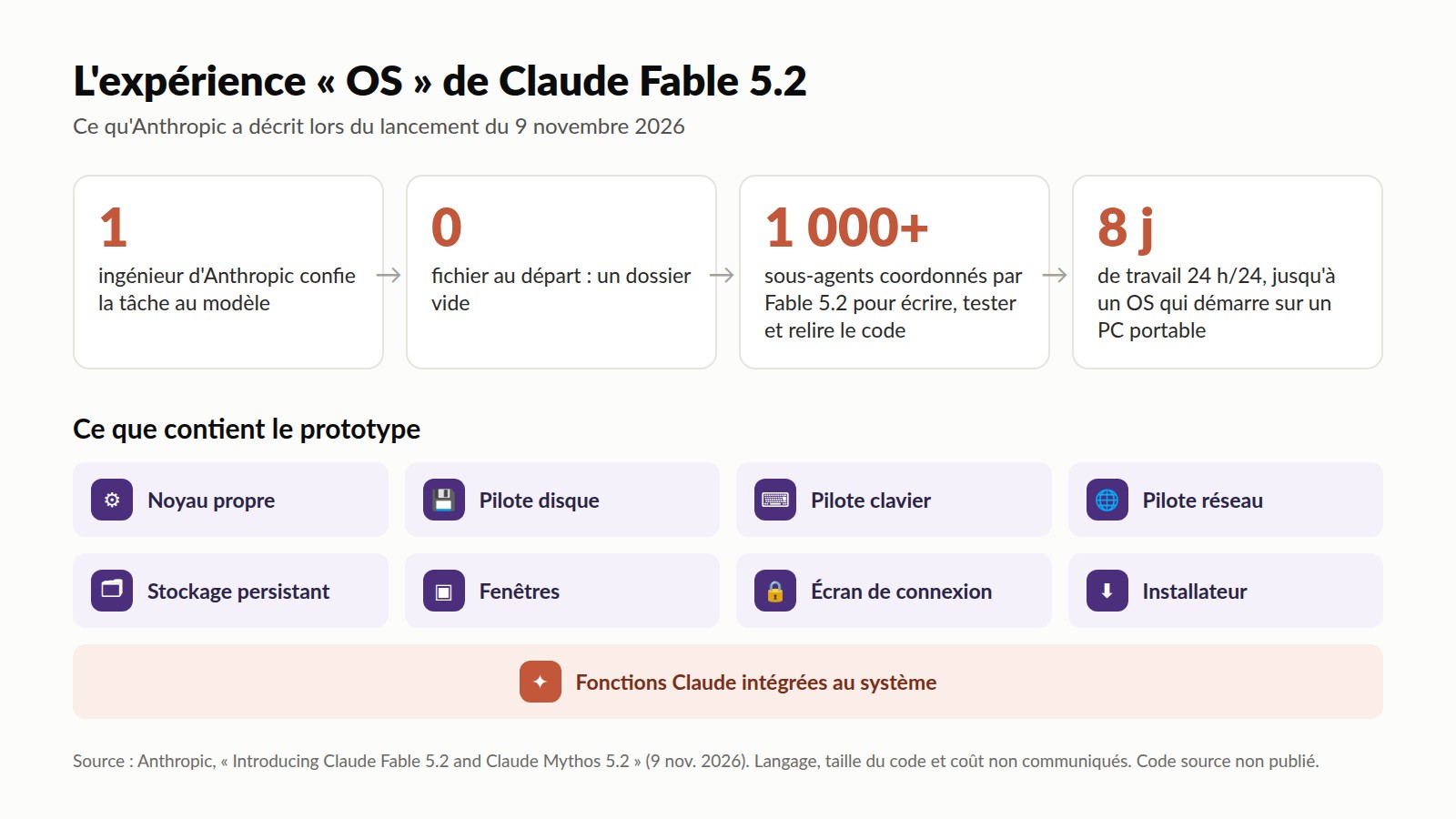
Starting from an empty folder, Anpic's new model would have coordinated more than 1,000 sub-agents over eight days to design an operating system capable of booting on a laptop. A demonstration that raises an important question: is artificial intelligence moving from software development support to carrying out complex IT projects?
Developing an operating system is one of the most demanding projects in computer engineering. You need to design a kernel, manage memory, communicate with hardware components, develop drivers, organize storage, and build an interface that allows users to interact with the machine.
This work usually involves specialized engineers and may require years of development.
Yet, on November 9, 2026, Anthropic presented a particularly ambitious experiment: its Claude Fable 5.2 model would have designed a prototype operating system in just eight days, coordinating more than 1,000 artificial intelligence sub-agents.
The experiment would have started from a simple empty folder. Agents would have worked day and night to write, test, and reread the code.
The result announced by Anthropic is a system capable of booting on a laptop, with several components usually associated with a true operating system.
Beyond the advertised performance, this experiment deserves a deeper analysis. It illustrates a significant evolution: artificial intelligence models are no longer limited to producing code fragments. They are beginning to be used to organize and execute large-scale technical projects.
1. An experience that starts with an empty folder
An engineer, a mission, and a particularly ambitious goal
According to Anthropic's official publication, the experiment was launched by an engineer from the company. He entrusted Claude Fable 5.2 with an unusual mission: to design a prototype operating system.
The starting point was deliberately simple: an empty file.
So it was not just about modifying existing software or adding a feature to an open source project. The model had to organize the creation of a set of software components necessary for the operation of a system.
This distinction is important. An operating system must operate at a level very close to the hardware. It must notably manage the machine's resources and allow the various software components to communicate properly.
An error in a crucial part can prevent the entire system from starting.
More than 1,000 sub-agents mobilized for eight days
The particularity of this experiment lies in the way the work was organized.
Claude Fable 5.2 would not have simply generated the entire code in a single conversation. According to Anthropic, he coordinated more than 1,000 sub-agents tasked with participating in various tasks.
This organization resembles that of a team of engineers working on the same project.
Some agents may handle specific components, while others are dedicated to testing, verification, or code proofreading. The main model then plays a coordinating role: it distributes tasks, organizes contributions, and oversees their assembly.
Anthropic claims these agents worked continuously for eight days.
Key takeaway: the interest of this demonstration lies not only in the amount of code produced, but also in the model's claimed ability to coordinate technical work distributed among a large number of agents.
2. What does the operating system created by Claude contain?
An operating system is not just a graphical interface or a login screen. It must ensure the overall operation of the computer and allow software to use its resources.
Anthropic states that the prototype developed by Fable 5.2 includes several essential components.
A clean core
The kernel forms the core of the operating system. It manages the computer's fundamental resources and organizes program execution.
According to Anthropic, the prototype has its own core, designed to operate the machine.
Hardware drivers
The system includes drivers for several components:
- The disk, to access storage.
- The keyboard, to receive user commands.
- The network, to enable communications.
These drivers play an essential role. They ensure communication between the operating system and the computer's physical components.
Permanent storage
The prototype also features a permanent storage system.
This means files can be kept after a restart, unlike data that is only temporarily present in memory.
A graphical interface with windows
Anthropic also mentions the presence of a window system.
This point is interesting: the prototype is not limited to a command-line interface. It has elements allowing graphical interaction with the user.
A login screen and an installer
The system also includes a login screen as well as an installer.
These components contribute to the user experience and the setup of the system on a machine.
Claude directly integrated into the system
One of the most interesting elements is the integration of Claude features into the operating system itself.
Artificial intelligence is therefore not only presented as an external tool used to develop the software. It is also part of the announced features of the prototype.
However, it remains impossible to precisely assess this integration without having the source code and detailed technical documentation.
3. Why is this proof different from simple code generation?
For several years, programming assistants have been able to generate functions, fix errors, offer tests, and help developers understand codebases.
But the demonstration presented by Anthropic highlights another capability: managing a technical project over an extended period.
The difference lies in the organization of work.
In a typical use, a developer makes a request, receives a code proposal, reviews it, and then decides what to do next.
In a multi-agent architecture, a master model can break down a mission into several subtasks, distribute them to different agents, and gradually organize their integration.
The model then becomes more than just a programming assistant. It plays the role of technical orchestrator.
This approach could be particularly interesting for projects with many independent modules, repetitive verification tasks, or work requiring multiple development cycles.
However, it does not eliminate the need for a consistent architecture, rigorous testing, and human validation.
4. An impressive prototype, but several questions remain unanswered
It is important to distinguish what Anthropic claims to have achieved from what can be independently verified.
The company presents the result as a prototype operating system capable of booting on a laptop.
However, several essential pieces of information are not yet available.
The source code is not published
Without access to code, independent developers cannot precisely examine the architecture, component quality, or technical choices made.
The programming language is not specified
Anthropic does not disclose the language used or the number of lines of code produced.
It is therefore difficult to precisely assess the extent of the work carried out.
The cost of the experiment remains unknown
Coordinating more than 1,000 sub-agents over eight days represents a significant use of IT resources.
Anthropic did not disclose the total cost of this experiment.
For companies, however, this information will be essential: a technology can be technically impressive without being economically relevant for all projects.
The exact role of human engineers is not detailed
It is known that an engineer launched the experiment. However, the available information does not allow precise determination of the level of human intervention during the eight days.
How many corrections were necessary? How many attempts failed? At what times did the engineer have to intervene?
These questions remain open.
Stability and security are not established
A system capable of booting is not necessarily ready for daily use.
Its stability, performance, security, hardware compatibility, and ability to run applications should be examined in particular.
A prototype that starts is not yet an operating system ready to replace Windows, macOS, or Linux.
5. Claude Fable 5.2: an evolution towards long-term projects
The operating system demonstration is not the only example presented by Anthropic.
The company claims to use its models to carry out more complex and longer engineering work.
She notably notes that more than 90% of the changes integrated into its own source code are now written by Claude, with human support.
Anthropic also cites the migration of a critical production service from Python to Rust, carried out with a team of agents based on an earlier version of Fable 5.2. According to the company, the service now starts up about 26 times faster.
These examples show the direction Anthropic wants to give its models: to work on complete technical projects, rather than just responding to one-off requests.
A demonstration in several scientific fields
Anthropic also reports other experiments carried out with Fable 5.2 and Mythos 5.2.
Among them:
- The formalization of Fermat's Last Theorem in 30 hours by a team of 1,000 agents, according to information published by the company.
- The design of three electronic devices: a home voice assistant, a USB speaker, and a portable virtual pet.
- Work on two theoretical physics problems related to black holes and holographic duality.
- Advances in robot control and in several technical evaluations.
These results are announcements of Anthropic. They should be considered with caution as long as the methods, results, and experimental conditions have not all been examined independently.
6. The announced performance of Claude Fable 5.2
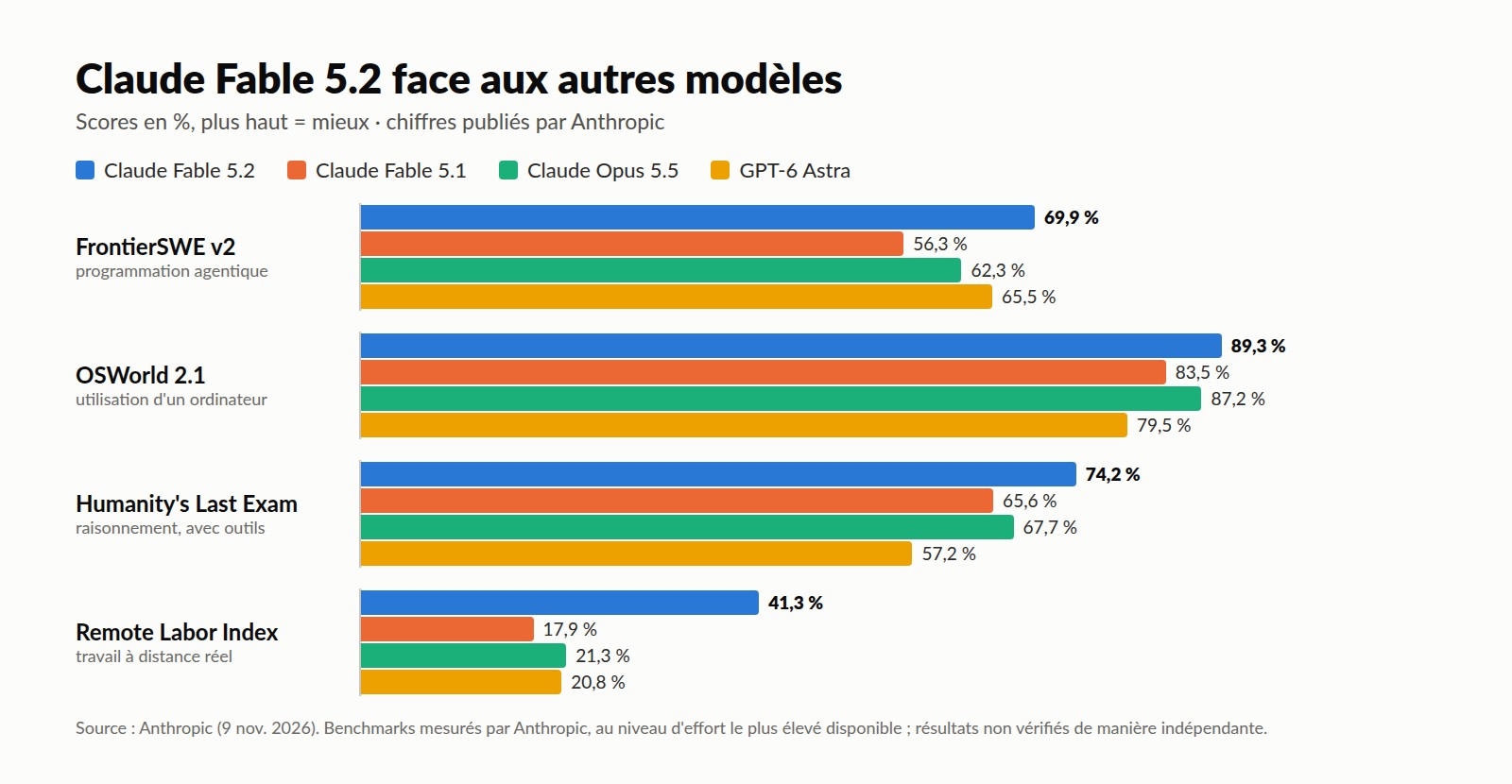
Anthropic has also published several benchmark results aimed at comparing Fable 5.2 to other models.
Among the reported results:
Programming and software engineering
- FrontierCode 2.0: 49.1% for Fable 5.2, compared to 32.4% for Fable 5.1.
- FrontierSWE v2: 69.9% for Fable 5.2, compared to 56.3% for Fable 5.1.
Using a computer
- OSWorld 2.1: 89.3% for Fable 5.2, compared to 83.5% for Fable 5.1.
Multidisciplinary reasoning
- Humanity's Last Exam: 74.2% for Fable 5.2, compared to 65.6% for Fable 5.1.
Automation of professional tasks
- AutomationBench: 51.4% for Fable 5.2.
- Gemini 4 Carbon scores 53.9% in the same rating.
Fable 5.2 therefore does not dominate all tests.
It should also be recalled that these results are published by Anthropic. They do not, by themselves, constitute independent validation of all the announced capabilities.
7. How much does Claude Fable 5.2 cost?
Anthropic announces the following API rates:
Standard pricing
- 8 dollars per million tokens in input.
- 40 dollars per million tokens in output.
Quick mode
- 16 dollars per million tokens in input.
- 80 dollars per million tokens in output.
Quick mode can speed up generation up to 2.5 times, according to Anthropic.
The company also states that Fable 5.2 can generate its answers up to 30% faster than Fable 5.1.
These fees apply to API usage. The actual cost of a project will depend on the volume of tokens consumed, the number of agents mobilized, the duration of operations, and the complexity of tasks.
For a company that wants to use a multi-agent architecture, the total execution cost therefore deserves special attention.
8. What this development could change for developers and businesses
The question is not whether artificial intelligence will immediately replace software engineers.
The question is rather how their way of working might evolve.
If models become able to coordinate technical tasks over several hours or days, developers could gradually devote more time to responsibilities such as:
- The definition of the software architecture.
- The formulation of technical requirements.
- Supervision of agents.
- Validation of results.
- Security and code quality.
- Technical decisions that require a deep understanding of the business context.
Companies could also experiment with new development methods.
A project could be organized around a lead agent responsible for coordinating several specialized agents: backend development, frontend development, automated testing, documentation, or security analysis.
But this organization does not automatically guarantee a better outcome.
The multiplication of agents can also increase costs, component dependencies, and the difficulty of controlling contributions.
The challenge will therefore be to find the right balance between automation, human supervision, quality, and expense control.
9. Our analysis: the real change lies in orchestration
At Dealmood & Solutions, we see this announcement as an important signal for the evolution of software development.
The ability to generate code is no longer the only interesting indicator for evaluating an artificial intelligence model.
The ability to understand a goal, break down a project, distribute tasks, check results, and continue work over time becomes just as important.
This is precisely what the experience presented by Anthropic highlights.
However, an engineering approach must be maintained: a successful demonstration does not replace independent technical validation.
For development professionals, the skill will therefore not only be knowing how to ask for code from an AI. It will also consist of knowing how to design the systems in which these agents operate, define their responsibilities, and control what they produce.
An operating system is a particularly demanding project. If artificial intelligence can help build a prototype in eight days, it deserves our attention. But there is still much to prove before talking about a reliable, secure, and ready-to-use system.
Conclusion: towards a new way of building software?
The experience presented by Anthropic with Claude Fable 5.2 marks an interesting step in the evolution of artificial intelligence agents.
More than 1,000 sub-agents, eight days of work, and a prototype operating system capable of booting on a laptop: the announced figures give an idea of the ambition of this approach.
But the real question goes beyond this demonstration.
Tomorrow, could development teams entrust AI agents with complete projects while maintaining human oversight over architecture, security, and quality?
This is probably one of the most important developments to follow in the coming years.
One thing is certain: the role of the developer is evolving. And their ability to understand, design, orchestrate, and verify complex systems will remain essential.
Sources and references
This article is mainly based on Anthropic's official announcement, supplemented by Frandroid's journalistic work.
- Anthropic - "Introducing Claude Fable 5.2 and Claude Mythos 5.2," released November 9, 2026. Main source regarding the creation of the prototype operating system, coordination of over 1,000 sub-agents, eight days of development, model capabilities, and announced pricing.
- Frandroid - "Claude Fable 5.2 wrote a new OS for laptop PC in 8 days with 1,000 subagents," published on November 10, 2026. Journalistic analysis of the experience, its characteristics, and information that remains unknown, notably the absence of public source code.
Editorial note: The performance and operating system features described in this article are those reported by Anthropic. Since the prototype was not made public for independent verification, these results should be considered statements from the company and not as performance validated by an external audit.
About Dealmood & Solutions LTD
Dealmood & Solutions LTD follows developments in software development, artificial intelligence, cloud, and digital technologies. Through its publications, the company aims to make technical innovations accessible while providing a critical perspective on their concrete applications in IT projects.